
Quantization
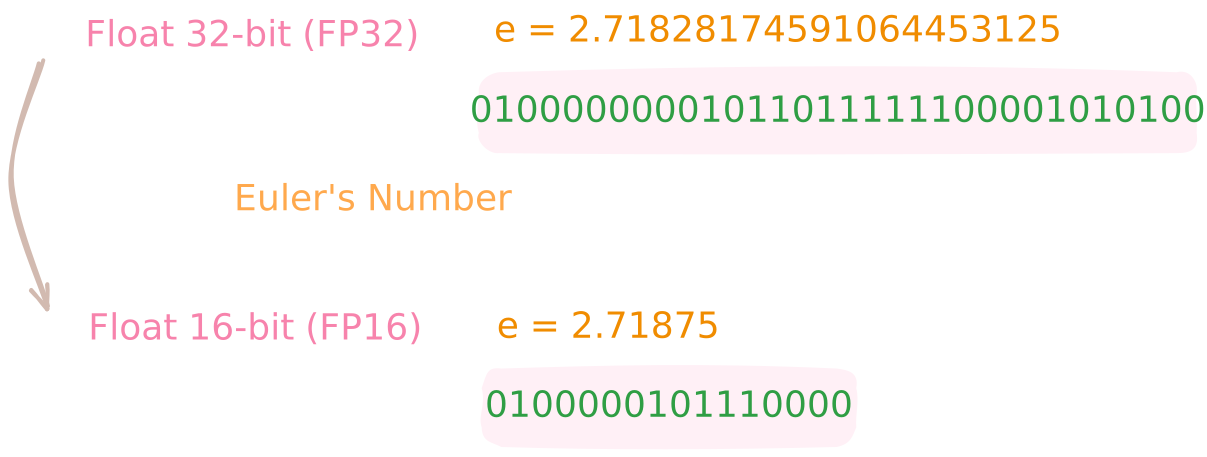
Quantization is a compression technique that transforms vectors from their original (specifically FP32) format into a more compact representation, reducing the size of vector indexes used for search.
This transformation approximates vectors using fewer bits per dimension — enabling:
- ✨ Lower memory footprint — especially when the index is memory-resident,
- ✨ Faster I/O and lower query latency — due to reduced data movement and efficient integer/fp16 arithmetic,
- ✨ Better scalability on resource-constrained hardware.
Important:
- Quantization is a lossy and irreversible compression method. It improves runtime efficiency at the cost of potentially reduced recall accuracy. Always validate its effect on your retrieval quality.
- Quantization only provides benefits when applied to vectors in a FP32 format.
Storage Behavior
To ensure data integrity and flexibility, Zvec stores both the original vectors and their quantized versions. This means:
- The overall on-disk storage usage may increase (due to storing two copies).
- However, only the quantized vectors are loaded into memory for indexing and search, significantly reducing the active index size.
- Users can always retrieve the original, unaltered vectors when needed.
Enabling Quantization
You can enable quantization at the time of vector index creation by selecting your preferred quantization type — e.g., FP16, INT8, or INT4 — using the quantize_type parameter in your VectorSchema.
Once set, Zvec automatically generates and manages the quantized representation alongside your original vectors.
Quantization Types
FP16 (Half-Precision Floating Point)
Uses 16-bit floating-point numbers to reduce memory footprint and accelerate computation while maintaining high numerical precision. Ideal for applications requiring near-FP32 accuracy with improved efficiency. Requires conversion from FP32 source.
INT8 (8-Bit Integer Quantization)
Represents vectors using 8-bit integers, significantly reducing storage and memory bandwidth requirements. Offers a good trade-off between speed, size, and retrieval accuracy for many similarity search tasks. Requires conversion from FP32 source.
INT4 (4-Bit Integer Quantization)
Ultra-compact representation using only 4 bits per dimension. Maximizes storage density and inference speed, suitable for latency-sensitive or resource-constrained environments where noticeable accuracy loss is acceptable. Requires conversion from FP32 source.
Enabling Rotation
When using INT8 or INT4 quantization, you can set enable_rotate=True via the quantizer_param parameter in your VectorSchema to enable rotation. This applies a random orthogonal rotation to vectors before quantization, making the distribution across dimensions more uniform, which reduces information loss during quantization and improves the recall of the quantized index.